A Little Grinchy, A Lot Gritty: What Therapists Really Need During the Holidays
Hey friend, pull up a blanket and sit with us for a minute.
We’re imagining you curled up on the couch–soft socks, maybe a candle going, maybe dishes still in the sink–scrolling this after a long day of sessions.
Outside, it’s holiday season.
Inside your body, it might feel… complicated.
Because while a lot of people are getting ready for cozy vacations, Hallmark movies, and big family gatherings, therapists are:
Carrying heavy stories
Holding space for other people’s grief, trauma, and loneliness
Trying to figure out what time off even looks like
Wondering if it’s okay to need a break
If you’ve secretly Googled things like:
“How do I set boundaries as a therapist during the holidays?”
“Can I really take a whole week off from my therapy practice at Christmas?”
“How do I handle suicidal clients before the holidays?”
You’re not alone.
You’re not dramatic.
You’re not weak.
You’re a therapist. And also a human.
We just want to sit with you, like friends by the fire with hot cocoa, and share a few real stories and gritty lessons that have shaped how we handle this time of year. So keep reading for our 4 Gritty Therapist Tips for the Holidays, or you can list to the most recent episode:
The Holidays Are a Both/And (and Therapists Feel That Double)
We’ll start with something light: movies.
Between the two of us, our families have watched it all — Elf, Home Alone, and yes, The Grinch Who Stole Christmas.
There are grandkids watching the Grinch now. There are grown kids who still quote Home Alone. There are arguments about only watching the OG Grinch cartoon, not the newer remakes.
But underneath the nostalgia, we both feel the same thing every year:
The holidays are joyful and difficult. It’s always both. As therapists, we sit in that “both” constantly:
You might love the lights and music…
…and dread the emotional load of the season
You might be excited to see family…
…and bracing yourself for old dynamics and new conflict
So here are four gritty, a-little-bit-Grinchy truths we’ve learned the hard way, that we hope land like a weighted blanket on your nervous system.
1. Be Grinchy With Your Schedule (Yes, Really)
Let’s start with Stef’s Husker story.
Stef lives in Nebraska. And in Nebraska, when the Huskers play in a bowl game, it’s basically its own holiday.
Years ago, she scheduled a full day of clients on Husker bowl game day.
At the same time:
Her whole family was at home
There was chili on the stove
Snow was falling–the pretty kind
Everyone was together, watching the game
And she was sitting in her office…watching clients cancel. Not the end-of-day clients. The ones right in the middle, when it’s too late to go home and too early to call it a day.
“I remember sitting there thinking, What did I do to myself? My family’s at home watching the snowfall,
and I’m alone in the office… and my clients aren’t even showing up.”
On top of that? There was that familiar therapist panic: “If I don’t work, I don’t get paid.”
We know that feeling well. That “I’ll go broke if I take time off” story is loud.
But here’s what experience has taught us:
Most clients want to be with their families too
Holiday-week cancellations are extremely common
When we over-schedule right up to the edge, we usually end up feeling resentful and drained
Cathy used to quietly judge other clinicians who took the day off….“I’d hear someone say they were taking the week and think, ‘Well, I’m working… I must be grittier than you.’ But really? I was just exhausting myself.”
Now, our advice–from one therapist friend to another–is simple:
Be a little Grinchy with your calendar.
Block out more time than you think you “should.”
Give yourself permission to not pack the days right before or after a holiday.
Protect your schedule like it actually matters–because it does.
Your worth is not measured by how close you work to Christmas Eve.
2. You Are Enough (Even When You’re Not Always On)
Here’s a story Stef still thinks about.
A few days before Christmas, a brand-new client walked into her office and disclosed serious suicidal ideation and a plan.
New client.
High risk.
Days before Christmas.
That moment every therapist knows in their body. So Stef and the client:
Created a safety plan
Identified supports
Set up a follow-up session on December 27th
Agreed to check in briefly by text over the next few days (not on Christmas Day, but around it)
And later, the client shared something that stuck:
Just saying it out loud and having someone hold it was a huge gift.
They didn’t need daily sessions or 24/7 contact. Stef didn’t have to cancel all of Christmas. The client just needed presence, attunement, and someone to be in it with them.
If your brain ever spirals into:
“Am I doing enough for my clients around the holidays?”
“Is it okay to take time off when I have high-risk clients?”
“Do I need to be on call the whole time?”
We want you to have this reminder woven into your nervous system:You are enough.
Your presence is enough.
Your steady, grounded, human self is enough.You can be responsible, ethical, thoughtful, trauma-informed
…and still take time off.
Those things are not opposites.
3. You Don’t Have to Fix Every Family Disaster
Now let’s talk about family drama–not yours (at least not yet), but your clients’.
Cathy has a longtime client whose family holiday tradition sounds like something from a dark comedy.
Every year, the extended family gets together for a big, elaborate gift exchange. It should be sweet. But it isn’t. Each year there are actual physical fistfights during the game. Kids are present, many old enough to feel the impact of the family dynamic.
Heading into one holiday season, Cathy could feel herself slipping into full-on over-responsible mode:
How do I help them all get through this?
What’s the plan for the kids?
How do we make this safer?
And then something very simple came out of her mouth: “What if you don’t go?”
The client paused. “I never thought about not going.”
That year, they didn’t go. Their immediate family opted out. Some extended family has gone back over time, but this client hasn’t returned.
Was it easy? No. They grieved the tradition. They felt sad. They cried.
But it also:
Protected their kids
Interrupted a harmful pattern
Built real, lived-in grit
Here’s why we’re telling you this:
If you tend to carry all the responsibility for your clients’ holiday outcomes–their safety, their family peace, their emotional experience–we see you.
And we want to gently offer:
You are not required to fix decades of family trauma in the last session before Christmas. You are allowed to ask questions like:
“What if you don’t go?”
“What would it be like to skip it this year?”
You are not the Holiday EMT for every system your clients belong to. Sometimes the grittiest, most loving invitation is: You don’t have to walk back into the chaos.
4. Take Off the Therapy Hat When You Leave
This might be the hardest part of all.
Therapists rarely stop working in their minds:
You’re wrapping gifts, but replaying court testimony in your head
You’re stirring a pot of soup, thinking about a suicidal safety plan
You’re looking at Christmas lights, but your brain is drafting intervention
Stef remembers walking into Hy-Vee on a cold Sunday morning:
Snow on the ground
Her whole family together
Christmas displays up
The store full of that cozy winter smell
She felt this warm little spark, “The holidays are coming.” And right next to it, another sensation, “But I have so much work to do.” Both lived there at the same time.
Instead of shaming herself for either feeling, she practiced noticing both, and then gently setting the “work” part off to the side for a while, like putting a file back on a shelf.
Cathy has her own ritual….
When she walks out of the office before a break, she imagines taking off her therapy hat before she reaches the car:
No email replies during actual time off
A simple “Happy Holidays” text back if someone reaches out warmly
A real response if there’s a true crisis
But not staying in “therapist mode” 24/7.
Years ago, a client once joked:
“You can never take a Christmas holiday ever again.”
It stuck with her for a long time. Fed that belief that she had to be always available. Now the
belief sounds more like this:
“I can be a good, present, grounded therapist… and I can turn my brain off when I walk out the door.”
We aren’t robots. We’re human. And our humanity is what makes us good at this.
A Gentle Holiday Challenge (From Our Couch to Yours)
If you were one of our therapists in The Gritty Academy, here’s what we would look you in the eye and say:
You do not have to push yourself to the edge to be a good therapist.
You do not have to work every hour your clients will take.
You do not have to be the emotional glue holding everyone together.
You do not have to be “on” all December to prove you care.
This year, we’re inviting you to:
Be a little Grinchy with your schedule.
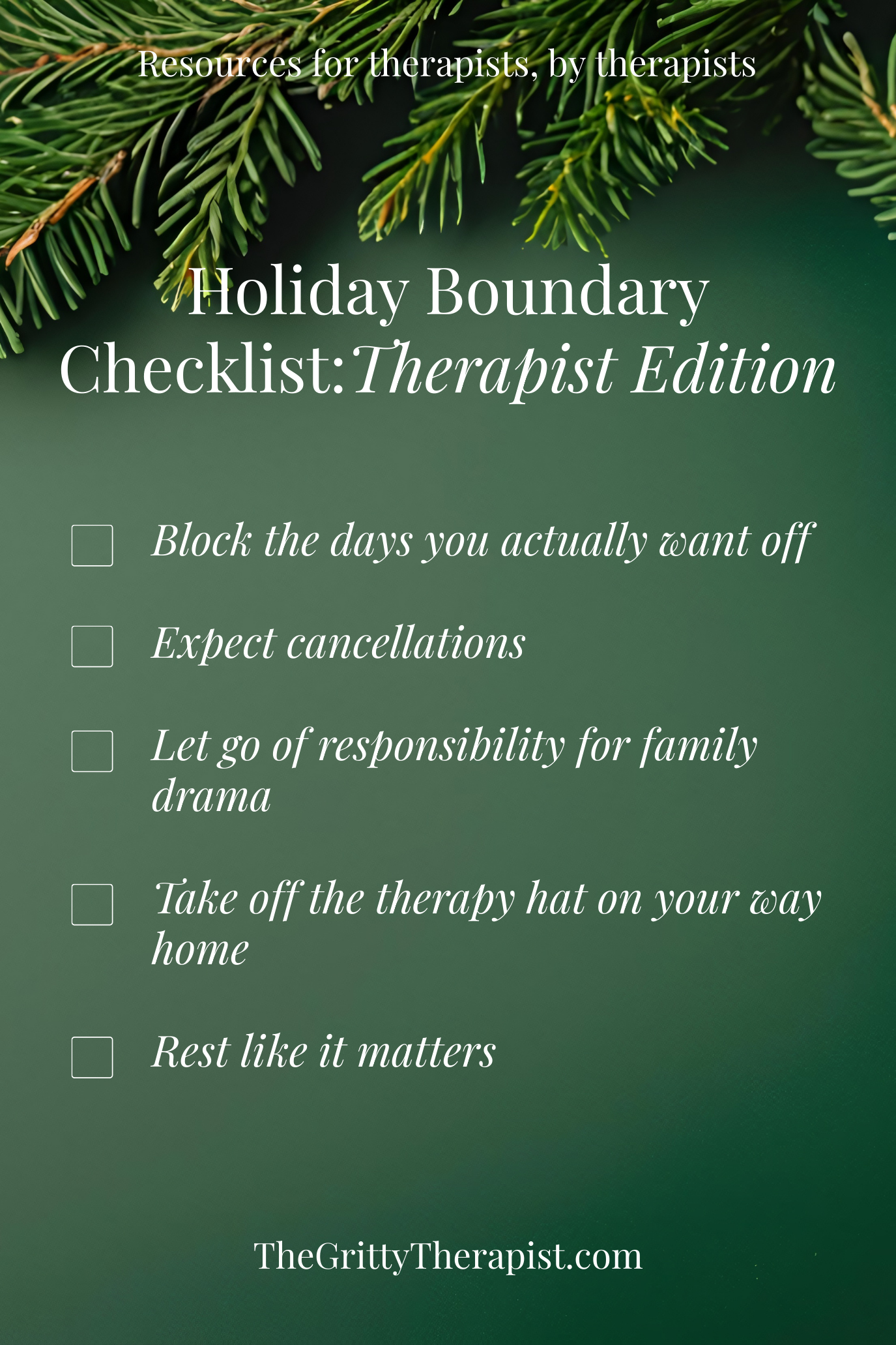
Block time off. Expect cancellations. Protect your days like they matter.Remember that you really are enough.
Your presence, your planning, and your care go a long way.Let go of over-responsibility for every family system.
You can listen, reflect, and still say: “What if you didn’t go?”Take off the therapy hat when you walk out.
Practice turning that part of your brain off, even for a little while.
You are a therapist. You are also a person who deserves rest, laughter, cozy pajamas, and days where you’re not holding everyone else’s story.
We’re in this with you.
Happy holidays, friend.
Go get your grit on.
Stef + Cathy